
Choosing a home broadband plan usually comes down to three questions: how fast do I actually need it, do I want OTT apps bundled in, and how much am I paying for it every month. ACT Fibernet is one of the most popular fiber broadband choices in India for a reason — consistent speeds, unlimited data, and flexible plans that scale from light browsing to a house full of streamers and gamers.
This guide breaks down ACT WiFi plans, what each speed tier is actually good for, and how to pick the right one without overpaying for bandwidth you’ll never use.
Why Choose ACT Fibernet for Home Internet
ACT runs on fiber-optic cable straight to your home, not shared copper lines, which means the speed you’re promised is much closer to the speed you actually get — even during peak evening hours when everyone in the building is online at once. A few things make it a strong pick for most households:
- Truly unlimited data on every plan — no hidden FUP (fair usage policy) throttling after a certain limit
- Free WiFi router and free installation included with every connection
- OTT bundles available — Netflix, Amazon Prime, JioHotstar, ZEE5, SonyLIV, and more, built directly into select plans
- Flexible billing cycles — 1 month, 3 months, or 6 months, with better effective pricing on longer cycles
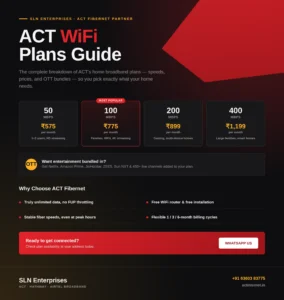
ACT WiFi Plans Breakdown (Without OTT)
These plans are ideal if you already have your own streaming subscriptions and just want fast, reliable internet without paying for bundled apps you won’t use.
| Speed | Monthly Price | Best For |
|---|---|---|
| 50 Mbps | ₹575/month | 1–2 users, browsing, video calls, HD streaming |
| 100 Mbps | ₹775/month | Small families, multiple devices, HD/4K streaming |
| 200 Mbps | ₹899/month | Work-from-home households, gaming, heavy multi-device use |
| 400 Mbps | ₹1,199/month | Large families, smart homes, 4K streaming on multiple screens |
Pricing shown is for the 1-month billing cycle. 3-month and 6-month packages bring the effective monthly cost down further.
ACT WiFi Plans Breakdown (With OTT Bundled)
If you’re going to subscribe to streaming apps anyway, the OTT-bundled plans are usually the better deal — you get the internet connection and the entertainment subscriptions in a single bill.
| Speed | Monthly Price | OTT Apps Included |
|---|---|---|
| 50 Mbps | ₹675/month | JioHotstar, ZEE5, Sun NXT, YuppTV, 450+ live channels |
| 100 Mbps | ₹949/month | Amazon Prime Lite, JioHotstar, ZEE5, Sun NXT, YuppTV, 450+ channels |
| 100 Mbps | ₹1,049/month | Amazon Prime, Netflix, JioHotstar, ZEE5, Sun NXT, YuppTV, 450+ channels |
| 200 Mbps | ₹1,249/month | Amazon Prime, Netflix, JioHotstar, ZEE5, Sun NXT, YuppTV, 450+ channels |
How Much Speed Do You Actually Need?
It’s easy to default to “get the fastest one,” but matching the plan to your household saves real money every month.
50 Mbps comfortably handles a couple of people browsing, video calling, and streaming HD content on one or two screens at a time. It’s the right pick for individuals, couples, or small households without heavy simultaneous usage.
100 Mbps is the sweet spot for most Indian households today — a family of 3–4 streaming on different devices, attending video calls, and gaming without buffering or lag, all at the same time.
200 Mbps makes sense once you’ve got a genuinely connected home — multiple 4K streams running simultaneously, competitive online gaming where latency matters, and several people working or studying from home on video calls at once.
400 Mbps and above is built for power users — large households with 6+ devices, smart home setups with dozens of connected devices, content creators uploading large files, or anyone who simply doesn’t want to think about bandwidth ever again.
1 Month vs. 3 Months vs. 6 Months: Which Billing Cycle Saves More?
ACT’s longer billing cycles bring the effective monthly cost down noticeably compared to paying month-to-month. For example, a 100 Mbps plan without OTT works out to roughly ₹775/month if you pay monthly, but drops closer to ₹678–₹679/month on the 3-month package and around ₹677/month on the 6-month package (GST included). If you’re confident you’ll be at the same address for a while, committing to a 3-month or 6-month cycle is the easiest way to lower your effective monthly bill without downgrading your speed.
Installation and Setup: What to Expect
ACT connections come with a free WiFi router and free installation on every plan, and setup is typically completed within a day or two of booking, subject to fiber availability at your address. Once installed, most routers support dual-band WiFi, so you get both a stable 2.4GHz signal for whole-home coverage and a faster 5GHz band for devices placed closer to the router.
Frequently Asked Questions
Is ACT Fibernet available in my area? ACT’s fiber network covers most major residential areas across its serviceable cities, but availability depends on your exact address. The quickest way to check is to share your address and PIN code when booking — a local provider can confirm coverage and installation timelines for you.
What is the difference between plans with and without OTT? Plans without OTT give you just the internet connection at a lower price. Plans with OTT bundle streaming apps like Netflix, Amazon Prime, and JioHotstar directly into your bill — usually cheaper than subscribing to those apps separately if you were going to get them anyway.
Is ACT’s “unlimited” data really unlimited? Yes — ACT’s home broadband plans come with truly unlimited data and no fair-usage throttling, meaning your speed doesn’t drop after hitting a data cap the way some plans from other providers do.
Can I upgrade my ACT plan later if I need more speed? Yes, ACT allows plan upgrades if your household’s usage grows — for example, if you add more devices, start working from home, or want higher speeds for gaming or 4K streaming. It’s usually simpler to start with a plan close to your needs and upgrade later than to overpay for unused bandwidth upfront.
Which ACT plan is best for online gaming? For casual gaming, 100 Mbps is generally sufficient. For competitive or latency-sensitive gaming, especially alongside other household usage, 200 Mbps gives more consistent performance and headroom.
Final Thoughts
The right ACT WiFi plan comes down to matching speed to how your household actually uses the internet — not just picking the biggest number available. Most families do well on 100–200 Mbps, light users can save money at 50 Mbps, and power users with smart homes or heavy streaming should look at 400 Mbps and above.
If you’re ready to get connected, SLN Enterprises helps set up ACT, Hathway, and Airtel broadband connections with free installation and same-week setup in most areas.