Introduction
In today’s connected world, a reliable internet connection is no longer a luxury—it’s an essential part of everyday life. From attending online classes and working remotely to streaming ultra-high-definition videos, playing online games, and managing smart home devices, nearly every digital activity depends on fast and stable internet.
As technology continues to evolve, traditional broadband connections are gradually being replaced by Fiber Broadband, a modern solution that delivers exceptional speed, lower latency, and greater reliability.
But what exactly is Fiber Broadband? How does it work? And why are millions of households and businesses switching to fiber connectivity?
This comprehensive guide answers these questions and explains why Fiber Broadband has become the preferred choice for modern internet users.
What Is Fiber Broadband?
Fiber Broadband is a high-speed internet service that uses fiber-optic cables to transmit data through pulses of light rather than electrical signals.
Unlike traditional copper-based connections, fiber-optic technology can carry significantly more data over longer distances with minimal signal loss.
This enables users to enjoy:
- Faster download speeds
- Faster upload speeds
- Stable internet performance
- Lower latency
- Better reliability
- Consistent connectivity during peak usage
Whether you’re attending virtual meetings, streaming 4K movies, or connecting multiple smart devices, Fiber Broadband provides the speed and stability required for today’s digital lifestyle.
How Does Fiber Broadband Work?
Fiber Broadband relies on ultra-thin strands of glass or plastic called optical fibers.
Instead of transmitting electrical signals, these fibers carry data using light.
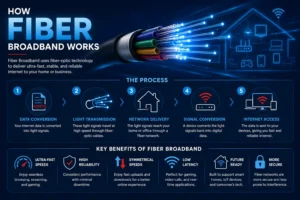
Here’s how the process works:
- Data is converted into light signals.
- These signals travel through fiber-optic cables at extremely high speeds.
- A receiver converts the light signals back into digital information.
- Your modem or router distributes the internet connection throughout your home or office.
Because light travels faster and experiences less interference than electricity, fiber connections offer significantly better performance than conventional broadband technologies.
Types of Broadband Connections
Several internet technologies are available today, each with its own advantages and limitations.
DSL Broadband
DSL uses existing telephone lines to provide internet access.
Although widely available, its speed often decreases as the distance from the exchange increases.
Cable Broadband
Cable internet uses television cable infrastructure.
It generally offers higher speeds than DSL but may slow down during peak hours when many users share the same network.
Wireless Broadband
Wireless broadband delivers internet using mobile networks or radio signals.
It is convenient in remote locations but can be affected by weather conditions, network congestion, and signal strength.
Fiber Broadband
Fiber Broadband uses dedicated fiber-optic cables that provide:
- High-speed connectivity
- Stable performance
- Low latency
- Reliable upload and download speeds
- Excellent scalability
Among all available technologies, Fiber Broadband delivers the most consistent and future-ready internet experience.
Why Fiber Broadband Is Different
Many people focus only on internet speed, but the quality of a connection depends on several factors.
Fiber Broadband stands out because it offers more than just higher speeds.
Superior Reliability
Fiber cables are less vulnerable to environmental interference, helping maintain a stable connection even during heavy usage.
Symmetrical Upload and Download Speeds
Traditional broadband often provides fast downloads but slower uploads.
Fiber broadband typically offers much better upload performance, making it ideal for:
- Video conferencing
- Cloud storage
- Remote work
- Live streaming
- Online collaboration
Lower Latency
Latency measures how quickly data travels between your device and the server.
Lower latency means:
- Faster gaming response
- Smoother video calls
- Better virtual meetings
- Improved cloud applications
Future-Proof Technology
As internet usage continues to grow, fiber broadband is built to support increasing demand without compromising performance.
It is designed for:
- Smart homes
- AI-powered applications
- IoT devices
- 8K streaming
- Cloud computing
- Remote businesses
Benefits of Fiber Broadband
Switching to fiber broadband offers several long-term advantages.
Lightning-Fast Speeds
Fiber connections support high-speed downloads and uploads, reducing waiting times for streaming, gaming, and file transfers.
Reliable Connectivity
Unlike older technologies, fiber broadband maintains stable performance even when multiple devices are connected simultaneously.
Better Work-from-Home Experience
Professionals working remotely require uninterrupted video calls, cloud access, and file sharing.
Fiber Broadband provides the reliability needed for productive remote work.
Enhanced Entertainment
With fiber broadband, users can enjoy the following:
- Buffer-free streaming
- Ultra HD and 4K videos
- Online gaming
- Smart TV connectivity
- Music streaming
without frequent interruptions.
Improved Business Productivity
Businesses depend on fast internet for communication, collaboration, customer service, and cloud-based applications.
Fiber Broadband helps improve efficiency while minimizing downtime.
Who Should Choose Fiber Broadband?
Fiber Broadband is suitable for almost everyone, including
- Families with multiple connected devices
- Remote professionals
- Students attending online classes
- Gamers
- Content creators
- Small businesses
- Large enterprises
- Smart home users
If your daily activities rely heavily on the internet, Fiber Broadband provides the performance needed for a seamless online experience.
Why More People Are Choosing Fiber Broadband in 2026
The way we use the internet has changed dramatically over the past few years.
Today, many households connect dozens of devices simultaneously, including smartphones, laptops, smart TVs, gaming consoles, security cameras, and smart home appliances.
Older internet technologies often struggle to handle this increasing demand.
Fiber Broadband is built to support modern digital lifestyles by delivering consistent speed, reliability, and performance across multiple devices at the same time.
As online activities continue to grow, Fiber Broadband is becoming the preferred internet solution for homes and businesses alike.
Fiber Broadband vs 5G: Which Is Better?
As internet technology advances, many people compare fiber broadband with 5G internet. While both offer impressive speeds, they are designed for different purposes.
Fiber Broadband provides internet through fiber-optic cables, ensuring consistent speed, lower latency, and reliable connectivity. On the other hand, 5G delivers internet wirelessly through mobile towers, making it suitable for users who require mobility.
For homes and businesses that rely on uninterrupted internet for work, streaming, gaming, and smart devices, Fiber Broadband remains the preferred choice.
| Feature | Fiber Broadband | 5G Internet |
|---|---|---|
| Speed | Excellent | Very Good |
| Stability | Excellent | Depends on network coverage |
| Latency | Very Low | Low |
| Weather Impact | Minimal | Can vary in some conditions |
| Best For | Homes & Businesses | Mobile Users |
| Multiple Devices | Excellent | Good |
While 5G is ideal for people on the move, Fiber Broadband continues to offer the most dependable experience for fixed locations.
Fiber Broadband vs Traditional Broadband
Not all broadband connections deliver the same performance. Traditional broadband technologies such as DSL and cable have served users for years, but increasing internet usage has highlighted their limitations.
| Feature | Fiber Broadband | Traditional Broadband |
|---|---|---|
| Download Speed | Very High | Moderate |
| Upload Speed | Very High | Often Limited |
| Latency | Very Low | Higher |
| Reliability | Excellent | Moderate |
| Signal Loss | Minimal | Higher |
| Future Ready | Yes | Limited |
For households with multiple connected devices or businesses running cloud-based applications, Fiber Broadband offers a noticeable improvement in performance.
How Much Internet Speed Do You Really Need?
Choosing the fastest available plan isn’t always necessary. The ideal speed depends on how you use the internet.
Basic Browsing
Suitable for:
- Social media
- Web browsing
- Online shopping
Recommended for light internet users.
Streaming & Entertainment
If you regularly watch HD or 4K videos on platforms like YouTube or OTT services, you’ll need higher bandwidth to enjoy uninterrupted playback.
Fiber Broadband helps eliminate buffering and provides a smoother viewing experience.
Remote Work & Online Learning
Video conferencing, cloud storage, virtual meetings, and online classes require a stable connection rather than just high download speeds.
Fiber Broadband offers reliable upload and download performance, making it ideal for professionals and students.
Gaming
Online gaming depends on:
- Low latency
- Stable connection
- Fast response time
Fiber Broadband provides all three, helping reduce lag and improve gameplay.
Smart Homes
Modern homes often connect several devices simultaneously, including:
- Smart TVs
- Security cameras
- Voice assistants
- Smart lighting
- IoT devices
- Smartphones
- Tablets
- Laptops
Fiber Broadband ensures these devices stay connected without affecting performance.
How to Choose the Right Fiber Broadband Plan
Selecting the right broadband plan involves more than comparing speeds.
Consider the following factors:
Number of Users
A single user has different requirements compared to a family or office with multiple connected devices.
Internet Usage
Think about how you primarily use the internet.
Do you:
- Stream videos?
- Work from home?
- Attend online classes?
- Play online games?
- Upload large files?
Your usage pattern should guide your plan selection.
Device Connectivity
Homes today often have ten or more internet-connected devices.
Choosing a plan that supports simultaneous usage helps maintain consistent performance.
Reliability
A stable connection is more valuable than occasional high speeds.
Reliable fiber broadband minimizes interruptions during important meetings, classes, or entertainment.
Common Myths About Fiber Broadband
Several misconceptions prevent people from switching to fiber broadband.
Let’s clear up a few of them.
Myth 1: Fiber Broadband Is Only for Businesses
Reality: Fiber Broadband is an excellent choice for homes, apartments, and small businesses alike.
Myth 2: Faster Internet Is Only Useful for Gamers
Reality: Families, students, professionals, and content creators all benefit from faster and more reliable internet.
Myth 3: Fiber Broadband Is Difficult to Install
Reality: Professional installation is straightforward, and many providers complete the setup quickly.
Myth 4: My Current Internet Is Good Enough
Reality: As more devices connect to your network, older technologies may struggle to keep up. Fiber Broadband is built to handle growing internet demands.
Tips to Improve Your Home Wi-Fi Performance
Even with Fiber Broadband, your Wi-Fi setup plays a crucial role in overall performance.
Follow these best practices:
- Place your router in a central location.
- Keep it away from thick walls and metal objects.
- Restart your router periodically.
- Update your router’s firmware.
- Use secure Wi-Fi passwords.
- Upgrade to modern Wi-Fi equipment when needed.
- Reduce interference from other electronic devices.
These simple steps can improve coverage, speed, and stability throughout your home.
Expert Insight
As homes and workplaces become increasingly connected, internet requirements continue to evolve.
A dependable connection is no longer just about speed—it’s about consistency, reliability, and the ability to support multiple users and devices simultaneously.
Fiber Broadband is designed to meet these demands, making it a practical long-term investment for both residential and commercial users.
The Future of Fiber Broadband
The demand for fast, reliable, and uninterrupted internet is growing every year. As technologies such as Artificial Intelligence (AI), cloud computing, smart homes, 8K streaming, and the Internet of Things (IoT) become part of everyday life, internet infrastructure must keep pace.
Fiber broadband is designed for this future.
Unlike older broadband technologies, fiber networks can support increasing data demands without compromising speed or reliability. This makes Fiber Broadband a long-term solution for homes, businesses, educational institutions, and enterprises.
In the coming years, fiber broadband will continue to power the following:
- AI-powered applications
- Smart homes
- Hybrid work environments
- Online education
- Cloud-based businesses
- Virtual reality (VR) and augmented reality (AR)
- Ultra HD and 8K streaming
- Connected devices and IoT ecosystems
Investing in fiber broadband today means preparing for tomorrow’s digital world.
Why Choose ACT Internet?
A reliable internet connection isn’t just about speed—it’s about delivering a seamless online experience every day.
ACT Internet is committed to providing fiber broadband solutions that support modern digital lifestyles.
Benefits of Choosing ACT Internet
- High-speed Fiber Broadband connectivity
- Reliable and consistent performance
- Low-latency network for gaming and video calls
- Plans for homes and businesses
- Stable connectivity for multiple devices
- Ideal for remote work and online learning
- Seamless streaming and entertainment
- Professional customer support
Whether you’re working from home, attending virtual meetings, streaming movies, or running a business, ACT Internet provides the connectivity you need.
Key Takeaways
Choosing the right internet connection is an important decision that affects productivity, entertainment, communication, and daily convenience.
Before selecting a broadband provider, consider:
- Internet speed requirements
- Number of connected devices
- Reliability of the connection
- Upload and download performance
- Customer support
- Scalability for future needs
Fiber Broadband excels in all these areas, making it the preferred choice for today’s connected world.
Frequently Asked Questions (FAQs)
1. What is Fiber Broadband?
Fiber Broadband is a high-speed internet connection that uses fiber-optic cables to transmit data through light signals, delivering faster and more reliable internet than traditional broadband.
2. Is fiber broadband faster than traditional broadband?
Yes. Fiber Broadband offers significantly higher download and upload speeds, lower latency, and more consistent performance.
3. Who should choose fiber broadband?
Fiber Broadband is suitable for families, professionals, students, gamers, content creators, and businesses that require reliable, high-speed internet.
4. Can fiber broadband support multiple devices?
Absolutely. Fiber Broadband is designed to handle multiple smartphones, laptops, smart TVs, gaming consoles, and smart home devices simultaneously.
5. Is fiber broadband suitable for remote work?
Yes. Its stable connection and fast upload speeds make it ideal for video conferencing, cloud collaboration, and remote work.
6. Does fiber broadband improve online gaming?
Yes. Low latency and stable connectivity help reduce lag and improve the overall gaming experience.